


| Issue |
Aquat. Living Resour.
Volume 39, 2026
Special Issue - Small pelagic fish in changing social-ecological systems
|
|
|---|---|---|
| Article Number | 12 | |
| Number of page(s) | 9 | |
| DOI | https://doi.org/10.1051/alr/2026005 | |
| Published online | 29 May 2026 | |
Research Article
Faster growth during their first year leads to increased oxidative damage in wild European sardines
1
UMR DECOD (Ecosystem Dynamics and Sustainability), L’Institut Agro, Ifremer, INRAE, Plouzané, France
2
Laboratory of Environmental Marine Sciences, Université de Brest, Ifremer, CNRS, IRD, Plouzané, France
3
UMR DECOD (Ecosystem Dynamics and Sustainability), L’Institut Agro, Ifremer, INRAE, Rennes, France
* Corresponding author: This email address is being protected from spambots. You need JavaScript enabled to view it.
Received:
18
November
2025
Accepted:
16
April
2026
Abstract
Despite major advantages associated with rapid growth, the variation in body size among individuals within a population remains remarkably large. Indeed, fast growth in itself might come at a cost in terms of oxidative stress. In the Bay of Biscay, sardines (Sardina pilchardus) face growth-related issues: body size at age 1 has declined substantially during the last decades, and sardines with higher growth during their first year have lower survival rates. We therefore tested the hypothesis that 1-yr-old sardines with larger body size exhibit higher levels of oxidative damage than their smaller conspecifics. To this end, we measured protein (protein carbonyl) and lipid (malondialdehyde) oxidative damage in dorsal muscle samples of sardines caught during five surveys conducted in the Bay of Biscay in spring and in autumn. We categorized “large” and “small” 1-yr-old sardines within each survey based on their length distribution, balancing their spatial coverage. As larger 1-yr-old sardines are more likely to be mature, which might influence the relationship between growth and oxidative damage, we included sardines’ maturity stage in our analyses. While there was no relationship between sardine body size and malondialdehyde levels, we found that larger sardines had greater protein carbonyl content compared with smaller ones. Furthermore, we found no evidence for the effect of maturity stage on either protein carbonyl or malondialdehyde levels. Overall, the greater accumulation of protein oxidative damage in larger sardines, regardless of their maturity stage, supports the hypothesis that faster growth might indeed lead to an oxidative cost in this wild fish species.
Key words: Oxidative damage / growth / Sardina pilchardus / physiology / small pelagic fish
Handling Editor: Nicolas Bez
© R. Huard et al., Published by EDP Sciences, 2026
 This is an Open Access article distributed under the terms of the Creative Commons Attribution License (https://creativecommons.org/licenses/by/4.0), which permits unrestricted use, distribution, and reproduction in any medium, provided the original work is properly cited.
1 Introduction
Despite major advantages conferred by rapid growth, such as higher survival rates for larval stages (Garrido et al., 2015) or increased reproductive output (Barneche et al., 2018), the growth variation among individuals in natural populations remains remarkably large. Individuals that differ in growth rates usually adopt different life-history strategies (Arendt, 1997). Indeed, the expression of a biological function is often associated with costs leading to trade-offs when the higher performance of one activity has negative consequences for other traits (Garland et al., 2022; Monaghan et al., 2009). For example, periods of accelerated growth are often associated with shorter lifespans while individuals experiencing delayed growth have longer lifespans (e.g., Lee et al., 2013). Such cost-driven trade-offs have deep physiological roots (Zera and Harshman, 2001), and it is therefore necessary to identify the physiological processes underpinning the variation in individuals’ growth.
Oxidative stress has been proposed as a physiological cost to individuals’ growth and as a mediator of trade-offs between life-history traits (Dowling and Simmons, 2009; Monaghan et al., 2009; Metcalfe and Alonso‐Alvarez, 2010). Oxidative stress mainly originates from the metabolism fueling the physiological processes involved in growth, reproduction, and survival. In mitochondria, the production of adenosine triphosphate (ATP) generates potentially toxic by-products: reactive oxygen species (ROS). ROS are highly reactive due to their unpaired valence electron in radical species, such as superoxide radical O2•− or hydroxyl radical •OH, or owing to their unstable bonds in non-radical species such as hydrogen peroxide H2O2 (Halliwell and Gutteridge 2015). Yet, these molecules can be quenched by several antioxidants such as superoxide dismutase or catalase enzymes (Lesser, 2006; Birnie‐Gauvin et al., 2017). When ROS accumulate beyond the neutralizing capacity of antioxidants, they can alter biological macromolecules, generating oxidative damage to lipids, proteins, or DNA. Oxidative stress results from these processes and is characterized by an imbalance between the production of pro-oxidant molecules and their scavenging by antioxidants.
The greater expression of a biological trait can come with an oxidative cost. In multiple taxa, a higher growth rate is associated with increased oxidative damage (e.g., in birds, Geiger et al., 2012; mammals, Christensen et al., 2016; fishes, Smith et al., 2016), especially in challenging environmental conditions (Marasco et al., 2017; Kim et al., 2019; Beauvieux et al., 2022). A high investment in other biological functions such as reproduction may also carry an oxidative cost in terms of increased oxidative damage (Guerra et al., 2012; Noguera, 2017). Such an accumulation of oxidative damage can in turn accelerate cellular senescence and alter organisms’ physiological functions, which could ultimately compromise their survival (Robert and Bronikowski, 2010; Lee et al., 2013; Christensen et al., 2016). Therefore, besides being a marker of cost, oxidative stress plays a key role in the expression of trade-offs between growth and lifespan (Metcalfe and Monaghan, 2003). Intrinsic physiological mechanisms, such as oxidative stress, that could shed light on processes at the core of life-history trade-offs remain largely underexplored in wild fish populations (Birnie‐Gauvin et al., 2017; Brosset et al., 2021).
Small pelagic fish are fast-growing organisms of primary ecological importance due to their intermediate position in trophic networks (Pikitch et al., 2012). In addition, they represent a marine resource of substantial economic value (25% of global fish catches; FAO, 2024) and constitute high-quality sources of proteins and micronutrients for human consumption (Gladyshev et al., 2018; Robinson et al., 2022; Mathieu-Resuge et al., 2023;Guillot et al., 2026). Around the globe, multiple small pelagic fish populations have experienced major declines in body size during the past decades (Olafsdottir et al., 2016; Canales et al., 2018; Hay et al., 2019; Saraux et al., 2019; Kamimura et al., 2021; Taboada et al., 2024). Sardines (Sardina pilchardus) from the Bay of Biscay are no exception, experiencing a sharp decline in length and weight at age, especially for 1-yr-old individuals whose average weight has halved since the mid-2000s (Doray et al., 2018; Véron et al., 2020a). In addition, Boëns et al. (2021) reported a consistent selective mortality in this population: sardines growing faster during their first year have shorter lifespans than slower-growing individuals. The disappearance of large age 1 sardines occurred even at low fishing rates (Boëns et al., 2023), suggesting other driving mechanisms. Potential explanations for these size shrinkages are extrinsic bottom-up processes such as a decline in food quantity or quality (Bertrand et al., 2022; Grandrémy, 2023; Menu et al., 2023). Yet, intrinsic physiological processes have thus far not been investigated, even though increased cellular damage may underpin the link between sardine growth at age 1 and their survival (e.g., in other study systems: Lee et al., 2013; Christensen et al., 2016). Therefore, we tested the hypothesis that rapid growth in 1-yr-old sardines comes with an oxidative damage cost. To this end, we used markers of oxidative damage, as they measure the actual outcome of oxidative stress and have been shown to reflect the oxidative cost of growth in several taxa (Costantini and Verhulst, 2009; Selman et al., 2012; Smith et al., 2016). Hence, we expected that large 1-yr-old sardines would have accumulated more oxidative damage on proteins and lipids than their smaller conspecifics had. In the Bay of Biscay, 1-yr-old sardines represent the only age group that is partially mature; for instance, in 2024, 47% of 1-yr-old sardines were immature (ICES, 2024). At this age, larger sardines are more likely to be mature than smaller individuals (Véron et al., 2020b). Since variations in reproductive investment can also influence oxidative damage levels (Guerra et al., 2012; Noguera, 2017), we included individuals’ maturity stage index in our analyses.
2 Material and methods
2.1 Sample collection
Sardines were caught in the Bay of Biscay on board the research vessel Thalassa during the annual scientific surveys “PELGAS” in spring (Doray et al., 2000) and “EVHOE” in autumn (Laffargue et al., 1987), using pelagic and bottom trawls, respectively. On board, sardines arrive dead or moribund. At each fishing station (Fig. 1), five to ten individuals of various sizes were selected. For each individual, we recorded total body length (±1 mm) and total mass (±1 g). Sex and maturity stages were determined through a macroscopic examination of the gonads. Maturity stage was assigned using the following scale: (1) immature, (2) developing, (3) pre-spawning, (4) spawning, (5) partial post-spawning, and (6) post-spawning (ICES, 2008). We grouped sardines staged 2 or higher in one “mature” group. The pair of otolith sagittae was removed, and the number of growth rings was read under a binocular microscope to determine each sardine’s age (ICES, 2019). Finally, we dissected a piece of dorsal muscle and stored it on board at −80°C. Once ashore, muscle samples were stored at − 70°C until further analyses. A total of 106 1-yr-old sardines were selected across four years: 22 sardines for each spring of 2021, 2022, and 2023; and 20 sardines for each autumn of 2020 and 2021. Within each survey, we selected half of the individuals among the smallest and half among the largest sardines, balancing the sampling among sites of the Bay of Biscay (see supplementary material, Fig. S1).
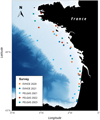 |
Fig. 1 Location of the sampling stations across the Bay of Biscay, n = 38. |
2.2 Oxidative damage assays
We measured two markers of oxidative damage, protein carbonyl and malondialdehyde levels, on dorsal muscle samples. Frozen samples of sardine muscle were cryogenically ground using a ball mill (Mixer Mill MM 400; Retsch). We subsampled the resulting powder in separate tubes for further oxidative damage assays and stored them at − 70°C.
Oxidation of protein amino acid side chains can lead to the irreversible formation of carbonyl groups (Halliwell and Gutteridge, 2015). Due to their high stability, protein carbonyl measurements are good biomarkers of oxidative damage accumulation on proteins (Monaghan et al., 2009). We assayed oxidative damage to proteins using the Cayman Protein Carbonyl Fluorometric Assay Kit on tissue homogenates (Ref. 701530; Cayman Chemical Company). The assay is based on the reaction of these groups with a hydrazide to form a fluorescent hydrazone. We added ice-cold phosphate-buffered saline (PBS) containing 1 mM EDTA to aliquots of sardine muscle powder to lead to a concentration of 100 mg of tissue per ml of buffer. We homogenized samples by vortexing before centrifugation at 10,000 g at 4°C for 15 min. Aliquots of 14 μl were collected from the supernatant and diluted by 10 using Protein Carbonyl Sample Diluent 1X. Then, we followed the manufacturer’s protocol to perform the assay, except that we left tubes open at room temperature for 75 min instead of 30 min to obtain dry protein pellets. After the last centrifugation, we transferred 100 μl of the supernatant to a black microtiter plate, and we kept an aliquot of 80 μl of the supernatant at − 70°C for further protein assay. We measured fluorometry in a microplate reader (Infinite 200 PRO; TECAN) using an excitation wavelength of 560 nm and an emission wavelength of 590 nm. We assayed individuals in duplicates. The technical repeatability of the protein carbonyl assay was excellent (r = 0.940, F = 32.460, and P < 0.001, as defined by Lessells and Boad, 1987).
Malondialdehyde is a by-product of lipid peroxidation (Halliwell and Gutteridge, 2015). We measured the quantity of malondialdehyde in sardine muscle using a colorimetric ALDetect Lipid Peroxidation Assay Kit (BML-AK170; Enzo Life Sciences). This assay is based on the reaction of malondialdehyde with two molecules of N-methyl-2-phenylindole, which, following acid heating, form a stable chromophore. We followed the manufacturer’s assay procedure for malondialdehyde quantification on tissue homogenates (hydrochloric acid solvent procedure). Ice-cold PBS buffer was added to aliquots of sardine muscle powder to lead to a concentration of 300 mg/ml. A volume of 10 μl of 0.5 M butylated hydroxytoluene in acetonitrile was added per ml of solution to prevent further oxidation. Samples were vortexed to form a homogenate and centrifuged at 5000 g at 4°C for 10 min. Aliquots of 100 μl were collected from the supernatant. One of them was kept at − 70°C for further protein determination. A volume of 325 μl of BML-KI527 Reagent R1 diluted at 1:3 volumes in BML-KI533 Diluent was added to each sample. Seventy-five microliters of 36.5% hydrochloric acid was added to each sample before a 45°C incubation for 60 min. Then, samples were centrifuged at 15,000 g for 10 min. Two hundred microliters of the supernatant were collected and transferred to a microtiter plate. We measured the absorbance at 586 nm using a microplate spectrophotometer within the next hour (Thermo Scientific Multiskan GO; Thermo Fisher Scientific). Individuals were assayed in triplicates (n = 41) or in duplicates (n = 65). The repeatability of the malondialdehyde assay was also excellent (r = 0.999, F = 2351.044, and P < 0.001).
Finally, we measured the protein concentration in homogenates used for the quantification of oxidative damage in proteins and in lipids using the Bradford method with the bovine serum albumin as the standard (Bradford, 1976). Homogenates were assayed in triplicates with again an excellent repeatability (r = 0.988, F = 241.649, P < 0.001). We found no difference in protein content between small and large sardines. Using the same procedure as Mathieu-Resuge et al., (2024), we determined the polyunsaturated fatty acid (PUFA) content of 63 sardines’ muscle samples and tested the relationship between malondialdehyde content and PUFA concentration (see supplementary material, Fig. S2 and Tab. S1). As we did not observe any strong relationship between these variables, we decided to normalize both protein carbonyl and malondialdehyde contents per mg of protein. Hence, we expressed protein carbonyl levels in pmol.mg−1 of protein and malondialdehyde content in nmol.mg−1 of protein.
2.3 Statistical analyses
We performed assessments of oxidative damage markers simultaneously in 2024 to prevent variation between processing batches of the assay. Hence, muscle samples were stored at −70°C for one to three years before being assayed. To account for any potential biases in oxidative damage levels induced by differences in storage time (Hõrak and Cohen, 2010), we standardized the measured oxidative damage concentrations within each survey. This method results in a z-score obtained by subtracting the group mean from the data point and dividing this result by the group standard deviation. We performed all further analyses on the obtained z-score values.
Pearson’s correlation coefficients between measures of malondialdehyde and protein carbonyl were positive, but their strength ranged from 0.440 to 0.833 between surveys (see supplementary material, Tab. S2). Therefore, we undertook all statistical analyses using the two markers of oxidative damage separately. To test the hypothesis that large 1-yr-old sardines have accumulated more oxidative damage than smaller ones, we defined two size classes (small and large) within each survey. We used the difference in mean total body length between large and small individuals, denoted delta (Tab. 1), as a weight in our analyses to give more weight to surveys in which the average length difference between large and small aged 1 sardines was higher. Results were qualitatively similar when we conducted analyses without the weights and based on total body length measurements instead of size classes (see supplementary material, Tabs. S5 and S6).
For each oxidative damage marker, we fitted linear mixed-effects models using protein carbonyl or malondialdehyde z-scores as the dependent variable and size class (two-level factor: small or large), maturity stage (two-level factor: immature or mature), and survey (five-level factor) as fixed effects. Since the timing of the survey can affect sardines’ size class, which can itself influence maturity stage, we tested the first-order interaction between size class and survey, as well as between size class and maturity stage (sample size of each group is provided in Tabs. S3 and S4). However, we did not attempt to test the interaction between maturity stage and survey due to a strongly unbalanced factorial design. To account for the non-independence of individuals sampled at the same location, we included the sampling station identifier as a random effect. We carried out stepwise backward model selections using the χ² statistic, i.e., we sequentially dropped the least significant interactions and then fixed effects until only significant explanatory variables remained. We carefully checked the residuals of the final models fitted for malondialdehyde and protein carbonyl levels to assess their normality and variance homogeneity. All analyses were carried out with R v.4.3.2 (R Core Team, 2025). Significant levels were determined using a P-value threshold of 0.05.
Size class definition within each survey; mean total body length of sardines in each size class is presented in mm as “mean (standard deviation)”. Delta is the difference in mean total length between large and small individuals within a survey, in mm.
3 Results
We found a significant effect of sardine size class on protein carbonyl content (Fig. 2 and Tab. 2), with larger sardines having consistently higher protein carbonyl levels than smaller ones (estimated mean difference of 0.533 ± 0.181 s.e.). We did not find that maturity stage, nor the interaction between size class and survey or between size class and maturity, significantly affects sardines’ protein carbonyl levels (Tab. 2).
None of the explanatory variables (size class, maturity stage, and survey) nor the interactions between size class and survey or between size class and maturity stage was significantly related to the variance in malondialdehyde content. Although the most parsimonious model was the null model (Fig. 3 and see supplementary material, Tab. S5a), the interaction between sardines’ size class and survey tended to be significant (see supplementary material, Tab. S5a: chi-square test, χ2 = 8.333, P = 0.080). This suggests that there might be some variation in the direction of the relationship between sardine size and malondialdehyde. In particular, malondialdehyde tended to be higher in larger sardines in surveys in which malondialdehyde levels strongly correlate with protein carbonyl content (see supplementary material, Fig. S3).
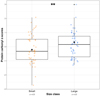 |
Fig. 2 Differences in sardines’ protein carbonyl z-scores regarding their size class. Sample sizes “n” within each group are specified below each boxplot. Black triangles represent protein carbonyl values predicted by the final model within each group. |
Linear mixed-effect model of protein carbonyl z-scores in response to size class and associated degrees of freedom (d.f.), estimates, and standard errors (s.e.). The intercept was set to size class = small, maturity stage = immature, and survey = EVHOE 2020.
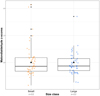 |
Fig. 3 Differences in sardines’ malondialdehyde z-scores regarding their size class. Sample sizes “n” within each group are specified below each boxplot. Black triangles represent malondialdehyde values predicted by the final model within each group. |
4 Discussion
Our analyses show that large 1-yr-old sardines sampled in four years and two seasons had greater protein carbonyl levels than their smaller counterparts. This result is in line with our hypothesis that sardines’ rapid growth at age 1 comes with an oxidative cost. Only a few studies have attempted to address this issue in wild fish (Birnie‐Gauvin et al., 2017), but this effect is consistent with several studies in other taxa showing that higher growth is associated with increased oxidative damage (e.g., in fish, Carney Almroth et al., 2010, 2012; birds, Geiger et al., 2012; mammals, Christensen et al., 2016; meta-analysis, Smith et al., 2016). At the sub-cellular level, this increase in protein oxidative damage in larger sardines suggests that the increased mitochondrial ATP production necessary to support rapid growth might have generated more ROS or diverted antioxidant systems, which resulted in an accumulation of oxidative damage. Although this mechanism of a high metabolic rate generating more oxidative stress is commonly assumed and is generally reported (Alonso‐Alvarez et al., 2004; De Block and Stoks, 2008; Dowling and Simmons, 2009; Boël et al., 2022), conflicting results have been observed in fish. For instance, it has been shown that wild brown trout (Salmo trutta) with higher metabolic rates had lower levels of ROS production (Salin et al., 2015). Therefore, it would be highly relevant to determine whether wild fast-growing sardines have more performant mitochondria and whether they generate more ROS to further identify the mechanisms underpinning the oxidative cost of growth. In addition, to have a more comprehensive understanding of the oxidative balance in this wild fish species, it would be of particular interest to assess antioxidant enzyme activity on the same individuals (Birnie‐Gauvin et al., 2017).
We found no significant differences in malondialdehyde content between large and small 1-yr-old sardines. This result might be surprising given the positive correlation observed between levels of malondialdehyde and protein carbonyl (suggesting that both markers capture overall sardines’ oxidative damage) and the positive relationship between protein carbonyl levels and sardine size at age 1. Such inconsistency in the effect of growth depending on the marker of oxidative damage has already been reported (Christensen et al., 2016) and might stem from the molecule of malondialdehyde itself. Indeed, this molecule is a reactive by-product of lipid peroxidation that can bind to protein amino acid side chains or DNA, which contributes to its relatively short-lived presence in cells (Halliwell and Gutteridge, 2015; Demirci-Çekiç et al., 2022). This might explain why the correlation between malondialdehyde– and protein carbonyl varied from 0.440 to 0.833 depending on the survey and the lack of a clear and consistent relationship between sardine size and malondialdehyde content across surveys. Despite the absence of a clear relationship between malondialdehyde and PUFA concentration in our study, examining this aspect could still be informative. Indeed, polyunsaturated fatty acids, due to their multiple double bonds, are particularly prone to peroxidation. Hence, differences in polyunsaturated fatty acid composition among individuals, influenced by sardines’ diet or metabolic strategies, could affect malondialdehyde levels independently of size (Guo et al., 2019). This process might effectively increase the variance in malondialdehyde levels and limit our ability to identify the links between individuals’ growth and lipid oxidative damage. In sardines, fatty acid composition of reserve lipids is particularly variable within the Bay of Biscay (Bertrand et al., 2022), and membrane fatty acid composition is strongly linked to sardine size (Mathieu-Resuge et al., 2024). Therefore, identifying the oxidative damage associated with individuals’ growth based on malondialdehyde alone might be possible but might require larger datasets to account for more confounding variables, such as malondialdehyde reactivity or muscle fatty acid composition.
Reproduction is a well-known driver of oxidative stress in many species, with higher reproductive investment being commonly associated with increased oxidative damage (Guerra et al., 2012; Noguera, 2017;Kurhaluk and Tkachenko, 2021) and reduced antioxidant defenses (Alonso‐Alvarez et al., 2004). In the Bay of Biscay, sardines’ reproductive period has two peaks, in spring and in autumn (Véron et al., 2020b), and we sampled sardines during these two reproductive periods. As we focused on 1-yr-old individuals, the only age class comprising both mature and immature sardines (ICES, 2024), and as larger sardines are more likely to be mature (Véron et al., 2020b), the greater levels of oxidative damage in larger sardines might have also stemmed from an increased resource allocation to reproduction. Nevertheless, our analyses revealed that neither sardines’ maturity stage nor their interaction with size class had a significant influence on protein carbonyl or malondialdehyde contents. Therefore, the greater level of oxidative damage on proteins in larger sardines is not due to individuals’ higher reproductive effort.
The relationship between increased oxidative costs and individuals’ growth might not be direct, as poor environmental conditions (e.g., increasing water temperatures or decreasing food availability or quality) might lead to simultaneous increases of oxidative stress (Marasco et al., 2017; Kim et al., 2019; Beauvieux et al., 2022). Clearly, cause-and-effect relationships are not possible to ascertain with this data collected in the wild. The sardines that we sampled experienced contrasting environments as they were caught during two seasons and four years. Yet, we found no significant interaction between sardines’ size class and survey meaning that the increase in protein carbonyl in large age 1 sardines was remarkably consistent. Moreover, we defined the “large” and “small” categories within each survey and carefully balanced the spatial distributions of the samples to limit the risk of consistent environmental differences between large and small sardines at a finer scale. Hence, it is unlikely that a joint dependence to seasonal and/or yearly differences in environmental factors underpins the increase in protein carbonyl with sardine size at age 1.
An accumulation of oxidative damage might accelerate cellular senescence (Stadtman and Levine, 2000) and affect future individual survival (Yin and Chen, 2005; Geiger et al., 2012; Christensen et al., 2016), although see Speakman et al. (2015). A recent study found that larger 1-yr-old sardines in the Bay of Biscay have a greater mortality (Boëns et al., 2021). As our analyses show that such larger individuals also present higher protein carbonyl content, it might be possible that the accumulation of protein oxidative damage in larger 1-yr-old sardines partly explains their increased mortality. Important changes in environmental conditions occurred in the Bay of Biscay over the last decades, but the sea surface temperature only slightly increased (Chust et al., 2022), making it unlikely to explain the increased mortality of large sardines (Boëns et al., 2021). Yet, the average size of mesozooplankton, making up the bulk of sardines’ diet (Bachiller, 2012), declined substantially (Grandrémy, 2023), and a bioenergetic approach indicates that declines in food quality may drive the decline in growth of small pelagic fish (Menu et al., 2023). It is therefore now important to extend this study to quantify directly the effects of environmental factors on the variations in the relationship between oxidative damage and individuals’ size. Another possibility would be to undertake experimental tests to disentangle the interplay between environmental factors, individuals’ growth, oxidative damage levels, and survival.
To conclude, the greater accumulation of protein oxidative damage in large individuals, regardless of their maturity stage, supports the hypothesis that faster growth can have an oxidative cost in this wild fish species. Thus, our study provides insights into the potential physiological costs associated with growth. Understanding these mechanisms is particularly important in the context of ongoing global warming, which may worsen the physiological constraints faced by wild organisms. Indeed, size shrinkages have been widely reported in numerous fish stocks over recent decades (Baudron et al., 2014), with direct consequences for fisheries, industries that rely on them, and food security (Quezada-Escalona et al., 2025).
Acknowledgments
We thank the scientific coordinators of PELGAS and EVHOE surveys, Mathieu Doray, Erwan Duhamel, Fanch Garren, and Pascal Laffargue, for enabling the collection of sardine tissue samples at sea. We are also grateful to the scientists and the crew of the research vessel Thalassa for their precious help during the sampling. In addition, we thank Claudie Quéré, Lauriane Madec, and Pauline Merrien for their helpful advice on oxidative damage assays. Finally, we thank the reviewers and the associate editor for their constructive comments and suggestions, which have improved the quality of this work.
Funding
This work was supported by Ifremer and the Région Bretagne (ARED), which funded the PhD thesis of Raphaëlle Huard, and by the Ecole Universitaire de Recherche ISblue (ANR-17-EURE-0015) and UMR DECOD, which funded the analyses.
Conflicts of interest
The authors have no relevant financial or non-financial competing interests to disclose.
Data availability statement
Data associated to this manuscript is available on the SEANOE repository in open access: https://doi.org/10.17882/113522.
Author contribution statement
Raphaëlle Huard: Conceptualization; Data collection and curation; Formal analysis; Investigation; Methodology; Visualization; Writing – original draft; Writing – review & editing. Karine Salin: Conceptualization; Funding acquisition; Investigation; Methodology; Project administration; Resources; Supervision; Validation; Writing – review & editing. Pablo Brosset: Conceptualization; Funding acquisition; Supervision; Investigation; Visualization; Writing – review & editing. Maxime Olmos: Funding acquisition; Supervision; Investigation; Validation; Writing – review & editing. Christophe Lebigre: Conceptualization; Funding acquisition; Methodology; Project administration; Resources; Supervision; Validation; Writing – review & editing.
Supplementary Material
Fig. S1. Selected sardines’ size distribution regarding latitude.
Fig. S2. Relationship between malondialdehyde level and PUFA concentration in sardine muscle.
Fig. S3. Representation of the relationships between sardine size class and malondialdehyde z-scores within each survey.
Table S1. Results of the model quantifying the effect of PUFA concentration on MDA level in sardines’ muscle.
Table S2. Pearson’s product moment correlation coefficient (PCC) between malondialdehyde and protein carbonyl levels within each survey.
Table S3a. Sample distribution of protein carbonyl data across size class and survey.
Table S3b. Sample distribution of malondialdehyde data across size class and survey.
Table S4a. Sample distribution of protein carbonyl data across size class and maturity stage.
Table S4b. Sample distribution of malondialdehyde data across size class and maturity stage.
Table S5a. Linear mixed models on malondialdehyde z-scores and associated degrees of freedom (d.f.), estimates, and standard errors (s.e.). This model is weighted using delta. The intercept is set to size class = small, maturity stage = immature, and survey = EVHOE 2020.
Table S5b. Linear mixed models on malondialdehyde z-scores and associated degrees of freedom (d.f.), estimates, and standard errors (s.e.). This additional model is not weighted using delta.
Table S5c. Linear mixed models on malondialdehyde z-scores and associated degrees of freedom (d.f.), estimates, and standard errors (s.e.). This additional model is fitted using sardines’ total body length instead of size class and is not weighted using delta.
Table S6a. Linear mixed models on protein carbonyl z-scores and associated degrees of freedom (d.f.), estimates, and standard errors (s.e.). This additional model is not weighted using delta.
Table S6b. Linear mixed models on protein carbonyl z-scores and associated degrees of freedom (d.f.), estimates, and standard errors (s.e.). This additional model is fitted using sardines’ total body length instead of size class and is not weighted using delta.
Access Supplementary MaterialReferences
- Alonso-Alvarez C, Bertrand S, Devevey G, Prost J, Faivre B, Sorci G. 2004. Increased susceptibility to oxidative stress as a proximate cost of reproduction. Ecol Lett 7: 363–368. [Google Scholar]
- Arendt JD. 1997. Adaptive intrinsic growth rates: an integration across taxa. Q Rev Biol 72: 149–177. [Google Scholar]
- Bachiller E. 2012. Trophic ecology of small pelagic fish in the Bay of Biscay: ecological effects of trophic interactions, PhD thesis, Universidad del País Vasco, 2012. [Google Scholar]
- Barneche DR, Robertson DR, White CR, Marshall DJ. 2018. Fish reproductive-energy output increases disproportionately with body size. Science 360: 642–645. [Google Scholar]
- Baudron AR, Needle CL, Rijnsdorp AD, Marshall CT. 2014. Warming temperatures and smaller body sizes: synchronous changes in growth of North Sea fishes. Glob Change Biol 20: 1023–1031. [Google Scholar]
- Beauvieux A, Queiros Q, Metral L, Dutto G, Gasset E, Criscuolo F, Fromentin J-M, Saraux C, Schull Q. 2022. Energy allocation trade-offs between life-history traits in the Mediterranean sardine: an ecophysiological approach. Mar Ecol Prog Ser 701: 99–118. [Google Scholar]
- Bertrand M, Brosset P, Soudant P, Lebigre C. 2022. Spatial and ontogenetic variations in sardine feeding conditions in the Bay of Biscay through fatty acid composition. Mar Environ Res 173: 105514. [Google Scholar]
- Birnie-Gauvin K, Costantini D, Cooke SJ, Willmore WG. 2017. A comparative and evolutionary approach to oxidative stress in fish: a review. Fish Fish 18: 928–942. [Google Scholar]
- Boël M, Veyrunes F, Durieux A-C, Freyssenet D, Voituron Y, Roussel D. 2022. Does high mitochondrial efficiency carry an oxidative cost? The case of the African pygmy mouse (Mus mattheyi). Comp Biochem Physiol A 264: 111111. [Google Scholar]
- Boëns A, Ernande B, Petitgas P, Lebigre C. 2023. Different mechanisms underpin the decline in growth of anchovies and sardines of the Bay of Biscay. Evol Appl 16: 1393–1411. [Google Scholar]
- Boëns A, Grellier P, Lebigre C, Petitgas P. 2021. Determinants of growth and selective mortality in anchovy and sardine in the Bay of Biscay. Fish Res 239: 105947. [Google Scholar]
- Bradford MM. 1976. A rapid and sensitive method for the quantitation of microgram quantities of protein utilizing the principle of protein-dye binding. Anal Biochem 72: 248–254. [CrossRef] [PubMed] [Google Scholar]
- Brosset P, Cooke SJ, Schull Q, Trenkel VM, Soudant P, Lebigre C. 2021. Physiological biomarkers and fisheries management. Rev Fish Biol Fish 31: 797–819. [Google Scholar]
- Canales CM, Adasme NA, Cubillos LA, Cuevas MJ, Sánchez N. 2018. Long-time spatio-temporal variations in anchovy (Engraulis ringens) biological traits off northern Chile: an adaptive response to long-term environmental change? ICES J Mar Sci 75: 1908–1923. [Google Scholar]
- Carney Almroth B, Johansson A, Förlin L, Sturve J. 2010. Early-age changes in oxidative stress in brown trout (Salmo trutta). Comp Biochem Physiol B 155: 442–448. [Google Scholar]
- Carney Almroth B, Johnsson JI, Devlin R, Sturve J. 2012. Oxidative stress in growth hormone transgenic coho salmon with compressed lifespan: a model for addressing aging. Free Radic Res 46: 1183–1189. [Google Scholar]
- Christensen LL, Selman C, Blount JD, Pilkington JG, Watt KA, Pemberton JM, Reid JM, Nussey DH. 2016. Marker-dependent associations among oxidative stress, growth and survival during early life in a wild mammal. Proc R Soc B 283: 20161407. [Google Scholar]
- Chust G, González M, Fontán A, Revilla M, Alvarez P, Santos M, Cotano U, Chifflet M, Borja A, Muxika I, Sagarminaga Y, Caballero A, De Santiago I, Epelde I, Liria P, Ibaibarriaga L, Garnier R, Franco J, Villarino E, Irigoien X, Fernandes-Salvador JA, Uriarte A, Esteban X, Orue-Echevarria D, Figueira T, Uriarte A. 2022. Climate regime shifts and biodiversity redistribution in the Bay of Biscay. Sci Total Environ 803: 149622. [Google Scholar]
- Costantini D, Verhulst S. 2009. Does high antioxidant capacity indicate low oxidative stress? Funct Ecol 23: 506–509. [Google Scholar]
- De Block M, Stoks R. 2008. Compensatory growth and oxidative stress in a damselfly. Proc R Soc B 275: 781–785. [Google Scholar]
- Demirci-Çekiç S, Özkan G, Avan AN, Uzunboy S, Çapanoğlu E, Apak R. 2022. Biomarkers of oxidative stress and antioxidant defense. J Pharm Biomed Anal 209: 114477. [Google Scholar]
- Doray M, Duhamel E, Huret M, Petitgas P, Massé J. 2000. PELGAS. [Google Scholar]
- Doray M, Petitgas P, Huret M, Duhamel E, Romagnan JB, Authier M, Dupuy C, Spitz J. 2018. Monitoring small pelagic fish in the Bay of Biscay ecosystem, using indicators from an integrated survey. Prog Oceanogr 166: 168–188. [Google Scholar]
- Dowling DK, Simmons LW. 2009. Reactive oxygen species as universal constraints in life-history evolution. Proc R Soc B 276: 1737–1745. [Google Scholar]
- FAO. The State of World Fisheries and Aquaculture 2024 - Blue Transformation in action, Rome, FAO, 2024. [Google Scholar]
- Garland T, Downs CJ, Ives AR. 2022. Trade-offs (and constraints) in organismal biology. Physiol Biochem Zool 95: 82–112. [Google Scholar]
- Garrido S, Ben-Hamadou R, Santos AMP, Ferreira S, Teodósio MA, Cotano U, Irigoien X, Peck MA, Saiz E, Ré P. 2015. Born small, die young: intrinsic, size-selective mortality in marine larval fish. Sci Rep 5: 17065. [Google Scholar]
- Geiger S, Le Vaillant M, Lebard T, Reichert S, Stier A, Le Maho Y, Criscuolo F. 2012. Catching-up but telomere loss: half-opening the black box of growth and ageing trade-off in wild king penguin chicks. Mol Ecol 21: 1500–1510. [Google Scholar]
- Gladyshev MI, Sushchik NN, Tolomeev AP, Dgebuadze YY, 2018, Meta-analysis of factors associated with omega-3 fatty acid contents of wild fish. Rev Fish Biol Fisheries 28: 277–299. [Google Scholar]
- Grandrémy N. Dynamiques spatio-temporelles du zooplancton, en lien avec l’habitat et les petits poissons pélagiques, dans le Golfe de Gascogne, PhD Thesis, Université de Nantes, 2023. [Google Scholar]
- Guerra C, Zenteno-Savín T, Maeda-Martínez AN, Philipp EER, Abele D. 2012. Changes in oxidative stress parameters in relation to age, growth and reproduction in the short-lived catarina scallop Argopecten ventricosus reared in its natural environment. Comp Biochem Physiol A Mol Integr Physiol 162: 421–430. [Google Scholar]
- Guillot A, Ngo Tona R, Connan S, Rouget M-L, Receveur J, Le Croizier G, Le Loc’h F, Buscaglia M, Munaron J-M, Ngoua Aba’a N, Petek S, Lorrain A, Schaal G, Sardenne F. 2026. Smoked fish from Gabon: nutritional benefits vs. contaminant risks. Food Control 180: 111643. [Google Scholar]
- Guo J, Zhou Y, Zhao H, Chen W-Y, Chen Y-J, Lin S-M. 2019. Effect of dietary lipid level on growth, lipid metabolism and oxidative status of largemouth bass, Micropterus salmoides. Aquaculture 506: 394–400. [Google Scholar]
- Halliwell B, Gutteridge JMC. Free Radicals in Biology and Medicine, 5th Ed, Oxford, Oxford University Press, 2015. [Google Scholar]
- Hay D, Schweigert J, Boldt JL, Thompson M. 2019. Temporal changes in size-at-age: Impacts and implications for reproductive biology, egg density and management of Pacific herring in British Columbia. Deep Sea Research Part II Top Stud Oceanogr 159: 42–51. [Google Scholar]
- Hõrak P, Cohen A. 2010. How to measure oxidative stress in an ecological context: methodological and statistical issues. Funct Ecol 24: 960–970. [Google Scholar]
- ICES. 2008. Report of the Workshop on Small Pelagics (Sardina pilchardus, Engraulis encrasicolus) maturity stages (WKSPMAT). ICES Scientific Reports. [Google Scholar]
- ICES. 2019. Workshop on Age reading of European Sardine (Sardina pilchardus) (NE Atlantic and Mediterranean) (WKARAS 2). ICES Scientific Reports. [Google Scholar]
- ICES. 2024. Working Group on Southern Horse Mackerel, Anchovy and Sardine (WGHANSA). ICES Scientific Reports. [Google Scholar]
- Kamimura Y, Taga M, Yukami R, Watanabe C, Furuichi S. 2021. Intra- and inter-specific density dependence of body condition, growth, and habitat temperature in chub mackerel (Scomber japonicus). ICES J Mar Sci 78: 3254–3264. [Google Scholar]
- Kim S, Noguera JC, Velando A. 2019. Carry‐over effects of early thermal conditions on somatic and germline oxidative damages are mediated by compensatory growth in sticklebacks. J Animal Ecol 88: 473–483. [Google Scholar]
- Kurhaluk N, Tkachenko H. 2021. Antioxidants, lysosomes and elements status during the life cycle of sea trout Salmo trutta m. trutta L. Sci Rep 11: 5545. [Google Scholar]
- Laffargue P, Salaun M, Garren F, Bellail R, Mahe J-C, Poulard J-C. 1987. EVHOE Evaluation Halieutique Ouest de l’Europe. [Google Scholar]
- Lee W-S, Monaghan P, Metcalfe NB. 2013. Experimental demonstration of the growth rate–lifespan trade-off. Proc R Soc B 280: 20122370. [Google Scholar]
- Lessells CM, Boag PT. 1987. Unrepeatable repeatabilities: a common mistake. Auk 104: 116–121. [Google Scholar]
- Lesser MP. 2006. Oxidative stress in marine environments: biochemistry and physiological ecology. Annu Rev Physiol 68: 253–278. [Google Scholar]
- Marasco V, Stier A, Boner W, Griffiths K, Heidinger B, Monaghan P. 2017. Environmental conditions can modulate the links among oxidative stress, age, and longevity. Mech Ageing Dev 164: 100–107. [Google Scholar]
- Mathieu-Resuge M, Brosset P, Sardenne F, Soudant P, Le Grand F, Schull Q, Lebigre C. 2024. How membrane fatty acids influence sardine size across diverse marine environments. Prog Oceanogr 221: 103209. [Google Scholar]
- Mathieu-Resuge M, Le Grand F, Brosset P, Lebigre C, Soudant P, Vagner M, Pecquerie L, Sardenne F. 2023. Red muscle of small pelagic fishes’ fillets are high-quality sources of essential fatty acids. J Food Compos Analysis 120: 105304. [Google Scholar]
- Menu C, Pecquerie L, Bacher C, Doray M, Hattab T, Van Der Kooij J, Huret M. 2023. Testing the bottom-up hypothesis for the decline in size of anchovy and sardine across European waters through a bioenergetic modeling approach. Prog Oceanogr 210: 102943. [Google Scholar]
- Metcalfe NB, Alonso‐Alvarez C. 2010. Oxidative stress as a life‐history constraint: the role of reactive oxygen species in shaping phenotypes from conception to death. Funct Ecol 24: 984–996. [Google Scholar]
- Metcalfe NB, Monaghan P. 2003. Growth versus lifespan: perspectives from evolutionary ecology. Exp Gerontol 38: 935–940. [Google Scholar]
- Monaghan P, Metcalfe NB, Torres R. 2009. Oxidative stress as a mediator of life history trade‐offs: mechanisms, measurements and interpretation. Ecol Lett 12: 75–92. [Google Scholar]
- Noguera JC. 2017. Interacting effects of early dietary conditions and reproductive effort on the oxidative costs of reproduction. PeerJ 5: e3094. [Google Scholar]
- Olafsdottir AH, Slotte A, Jacobsen JA, Oskarsson GJ, Utne KR, Nøttestad L. 2016. Changes in weight-at-length and size-at-age of mature Northeast Atlantic mackerel (Scomber scombrus) from 1984 to 2013: effects of mackerel stock size and herring (Clupea harengus) stock size. ICES J Mar Sci 73: 1255–1265. [Google Scholar]
- Pikitch EK, Boersma PD, Boyd IL, Conover DO, Cury P, Essington T, Heppell SS, Houde ED, Mangel M, Pauly D, Plagányi É, Sainsbury K, Steneck RS. 2012. Little fish, big impact: managing a crucial link in ocean food webs. Washington, DC, Lenfest Ocean Program. [Google Scholar]
- Quezada-Escalona FJ, Tommasi D, Kaplan IC, Hernvann P-Y, Frawley TH, Garcia D, Ibaibarriaga L, Sánchez-Maroño S, De Moor C, Beckensteiner J, Schueller AM, Feijó D, Ciorciaro D, Kurota H, Oliveros-Ramos R, Wildermuth RP, Mroch R, Wise L, Baker MR, Hansen C, Hemed SA, Brochier T, Stohs SM, Enciso-Enciso C, Jacobsen NS. 2025. Socio-economic impacts and responses of the fishing industry and fishery managers to changes in small pelagic fish distribution and abundance. Rev Fish Biol Fisheries 35, 1063–1093. [Google Scholar]
- R Core Team. 2025. R: A Language and Environment for Statistical Computing. [Google Scholar]
- Robert KA, Bronikowski AM. 2010. Evolution of senescence in nature: physiological evolution in populations of garter snake with divergent life histories. Am Nat 175: 147–159. [Google Scholar]
- Robinson JPW, Mills DJ, Asiedu GA, Byrd K, Mancha Cisneros MDM, Cohen PJ, Fiorella KJ, Graham NAJ, MacNeil MA, Maire E, Mbaru EK, Nico G, Omukoto JO, Simmance F, Hicks CC. 2022. Small pelagic fish supply abundant and affordable micronutrients to low- and middle-income countries. Nat Food 3: 1075–1084. [Google Scholar]
- Salin K, Auer SK, Rudolf AM, Anderson GJ, Cairns AG, Mullen W, Hartley RC, Selman C, Metcalfe NB. 2015. Individuals with higher metabolic rates have lower levels of reactive oxygen species in vivo. Biol Lett 11: 20150538. [Google Scholar]
- Saraux C, Van Beveren E, Brosset P, Queiros Q, Bourdeix JH, Dutto G, Gasset E, Jac C, Bonhommeau S, Fromentin JM. 2019. Small pelagic fish dynamics: a review of mechanisms in the Gulf of Lions. Deep Sea Res Part II Top Stud Oceanogr 159: 52–61. [Google Scholar]
- Selman C, Blount JD, Nussey DH, Speakman JR. 2012. Oxidative damage, ageing, and life-history evolution: where now. Trends Ecol Evol 27: 570–577. [Google Scholar]
- Smith SM, Nager RG, Costantini D. 2016. Meta-analysis indicates that oxidative stress is both a constraint on and a cost of growth. Ecol Evol 6: 2833–2842. [Google Scholar]
- Speakman JR, Blount JD, Bronikowski AM, Buffenstein R, Isaksson C, Kirkwood TBL, Monaghan P, Ozanne SE, Beaulieu M, Briga M, Carr SK, Christensen LL, Cochemé HM, Cram DL, Dantzer B, Harper JM, Jurk D, King A, Noguera JC, Salin K, Sild E, Simons MJP, Smith S, Stier A, Tobler M, Vitikainen E, Peaker M, Selman C. 2015. Oxidative stress and life histories: unresolved issues and current needs. Ecol Evol 5: 5745–5757 [Google Scholar]
- Stadtman ER, Levine RL. 2000. Protein oxidation. Ann NY Acad Sci 899: 191–208. [Google Scholar]
- Taboada FG, Chust G, Santos Mocoroa M, Aldanondo N, Fontán A, Cotano U, Álvarez P, Erauskin-Extramiana M, Irigoien X, Fernandes-Salvador JA, Boyra G, Uriarte A, Ibaibarriaga L. 2024. Shrinking body size of European anchovy in the Bay of Biscay. Glob Change Biol 30: e17047. [Google Scholar]
- Véron M, Duhamel E, Bertignac M, Pawlowski L, Huret M. 2020a. Major changes in sardine growth and body condition in the Bay of Biscay between 2003 and 2016: temporal trends and drivers. Prog Oceanogr 182: 102274. [Google Scholar]
- Véron M, Duhamel E, Bertignac M, Pawlowski L, Huret M, Baulier L. 2020b. Determinism of temporal variability in size at maturation of sardine Sardina pilchardus in the Bay of Biscay. Front Mar Sci 7. [Google Scholar]
- Yin D, Chen K. 2005. The essential mechanisms of aging: irreparable damage accumulation of biochemical side-reactions. Exp Gerontol 40: 455–465. [Google Scholar]
- Zera AJ, Harshman LG. 2001. The physiology of life history trade-offs in animals. Annu Rev Ecol Syst 32: 95–126. [Google Scholar]
Cite this article as: Huard R, Salin K, Brosset P, Olmos M, Lebigre C. 2026. Faster growth during their first year leads to increased oxidative damage in wild European sardines. Aquat. Living Resour. 39: 12. https://doi.org/10.1051/alr/2026005
All Tables
Size class definition within each survey; mean total body length of sardines in each size class is presented in mm as “mean (standard deviation)”. Delta is the difference in mean total length between large and small individuals within a survey, in mm.
Linear mixed-effect model of protein carbonyl z-scores in response to size class and associated degrees of freedom (d.f.), estimates, and standard errors (s.e.). The intercept was set to size class = small, maturity stage = immature, and survey = EVHOE 2020.
All Figures
|
Fig. 1 Location of the sampling stations across the Bay of Biscay, n = 38. |
| In the text | |
|
Fig. 2 Differences in sardines’ protein carbonyl z-scores regarding their size class. Sample sizes “n” within each group are specified below each boxplot. Black triangles represent protein carbonyl values predicted by the final model within each group. |
| In the text | |
|
Fig. 3 Differences in sardines’ malondialdehyde z-scores regarding their size class. Sample sizes “n” within each group are specified below each boxplot. Black triangles represent malondialdehyde values predicted by the final model within each group. |
| In the text | |
Current usage metrics show cumulative count of Article Views (full-text article views including HTML views, PDF and ePub downloads, according to the available data) and Abstracts Views on Vision4Press platform.
Data correspond to usage on the plateform after 2015. The current usage metrics is available 48-96 hours after online publication and is updated daily on week days.
Initial download of the metrics may take a while.