


| Issue |
Aquat. Living Resour.
Volume 39, 2026
Special Issue - Interdisciplinary issues on Manila and European clams in their socio-ecosystems
|
|
|---|---|---|
| Article Number | 4 | |
| Number of page(s) | 5 | |
| DOI | https://doi.org/10.1051/alr/2025022 | |
| Published online | 10 February 2026 | |
Research Article
The International Manila and European Clams Conference: Euro‐Mediterranean overview and future directions to support sustainable clam fisheries★
1
Ifremer, ASIM, Station de La Tremblade, Avenue de Mus de Loup, Ronce‐les Bains, 17390 La Tremblade, France
2
Ifremer, COAST, 1 allée du Parc Montaury, 64600 Anglet, France
3
Ifremer, COAST, 1 Quai du Commandant Silhouette, 33120 Arcachon, France
4
Université de Pau et des Pays de l'Adour, LMAP UMR CNRS 5142, 1 allée du parc de Montaury, 64600 Anglet, France
** Corresponding authors: This email address is being protected from spambots. You need JavaScript enabled to view it.
Received:
7
November
2025
Accepted:
4
December
2025
Abstract
The SYMPA symposium was initiated to improve knowledge and promote information exchange among stakeholders involved in clam fisheries and aquacultures. This initiative addressed the lack of coordinated research networks focused on European marine bivalves; a critical gap identified through two decades of research on clams. During the symposium, research highlighted the ecological and socio‐economic importance of the clam resources, primarily represented by the two key species Ruditapes philippinarum and Ruditapes decussatus, using a wide range of methodologies and providing integrative insights into population dynamics, ecosystem interactions, and combined fishery‐aquaculture applications. In the current context of declining stocks at several major European production sites, such a framework for scientific dialogue and knowledge dissemination is essential, as it supports evidence‐based decision‐making by resource managers and policymakers. Future directions proposed during the symposium highlight the necessity of adopting multidisciplinary and participatory approaches to ensure the sustainable management of clam populations. The establishment of a dedicated research network on clams would contribute to harmonize methodologies, enhance data sharing and interoperability, and underpin science‐based conservation and fisheries management.
Key words: Ruditapes philippinarum / Ruditapes decussatus / Europe / knowledge transfer and exchange / user of science / producer of science
Handling Editor: Pauline Kamermans and Pierre Boudry
Publisher note: An error occurred in the journal title. It was corrected on the first page of the PDF and in the running header on subsequent pages on 29 June 2026.
This work is licensed under a Creative Commons CC-BY 4.0 license by F. Riquet, F. Sanchez, E. Antajan, N. Bru, N. Caill-Milly.
© F. Riquet et al., Published by EDP Sciences 2026
 This is an Open Access article distributed under the terms of the Creative Commons Attribution License (https://creativecommons.org/licenses/by/4.0), which permits unrestricted use, distribution, and reproduction in any medium, provided the original work is properly cited.
1 Setting the scene
As scientists, our objective is to generate transparent and robust knowledge, while emphasizing the importance of multidisciplinary collaboration, to better understand and interpret complex data and phenomenon. In biology, such knowledge is particularly valuable when directly relevant to the management of natural resources (Kates et al., 2001; Cash et al., 2003; Fazey et al., 2013). However, scientific findings are not always accessible, understandable, or adequately communicated to stakeholders. Conversely, decision‐makers may be often unaware of existing scientific advances, which therefore remain insufficiently integrated into policy and management processes. This highlights the critical need for structured knowledge exchange among scientists, managers and local stakeholders, to foster mutual learning and support evidence‐based decision‐making (Cvitanovic et al., 2015; Karcher et al., 2024). Such exchanges are essential not only to advance scientific understanding of marine ecosystems and the services they provide, but also to translate this knowledge into state‐of‐the‐art advice to guide conservation, management, and sustainability strategies (e.g., Turner et al., 2003; Cvitanovic et al., 2016).
In marine fisheries, well‐established international networks already support stock management. For example, the International Council for the Exploration of the Sea (ICES) provides impartial scientific evidence on the status of the fish stocks (and some cephalopods and crustaceans stocks) and sustainable use of marine ecosystems in the Northeast Atlantic and Baltic Sea. The process leading to the production of coordinated scientific advice by ICES fully integrates the activity of methodological working groups enabling the harmonisation of practices regarding production of abundance, reproduction indicators, among others (https://www.ices.dk/Pages/default.aspx). Another example is the International Commission for the Conservation of Atlantic Tunas (ICCAT), which coordinates the conservation of tuna and tuna‐like species across the Atlantic Ocean and adjacent seas. Unlike fish, most bivalves display a benthic phase as adults once settled, making their life cycle relatively sedentary despite the initial pelagic larval stage. Due to this apparent sedentary life cycle, bivalve management is typically considered at a local or regional scale, and only occasionally at a national scale. As a result, scientific coordination for such coastal resources remains limited compared with that established for fish. However, even for bivalves such as clams, cross‐border connections do exist. They arise from their pelagic larval phase, which can last several weeks depending on the species and the temperature, from the exchange of spat in response to increasing mortality events, and from the transfer of adults to optimize growth under different environmental conditions. Such biological and operational links span multiple countries, highlighting the need for international coordination to facilitate knowledge exchange, harmonize protocols, and develop shared management practices across scientific, regulatory, and professional communities.
Over the past two decades of work on clams in Europe, we have identified a large and active scientific community. We therefore decided to organize a symposium in France with the primary objective of bringing these scientists together, inspired by the International Manila Clam Symposium that has been successfully held in Asia for several years [latest edition in 2024: 5th International Manila Clam (Asari) Symposium in Gunsan ‐ South Korea]. Subsequently, the scope of the symposium was broadened to include organizations directly involved in resource management, such as professional associations, government agencies, and marine protected area managers. For resources that appear to have a restricted spatial extent and mainly local and regional stakeholders, knowledge production takes often the form of technical reports rather than scientific publications. Consequently, the resulting information is generally poorly disseminated and not always easily identified by either the scientific community or resource managers. Beyond this objective of remedying this situation, organizing such an event can also encourage stakeholder engagement in the management which is also a key to successful resources management alongside improving the knowledge about resource dynamics and governance (Dutra et al., 2015). Moreover, while the Asian symposium focused on scientific issues relating to Ruditapes philippinarum, the symposium held in France also explicitly covered the grooved carpet shell Ruditapes decussatus, another clam of economic value in Europe.
2 Organization of the conference
The symposium ‐ named the SYMPA conference (“SYMposium international sur la PAlourde” in French, or “international clams SYMposium” in English) ‐ was held in Arcachon, one of France's historic ‐and regularly monitored‐ clam production sites. This international conference took place from 8 to 10 September 2025 with the first two days consisting of scientific presentations organized around five main themes:
Life‐history traits (reproduction, spawning, growth, mortality, health status, demography, etc.);
Evolutionary and functional processes (genetic diversity and structure, functional traits, selection, speciation, micro‐ and macroevolution, etc.);
Biotic interactions (trophic and spatial competition, pathogenicity, predation, co‐evolution etc.);
Habitat and environmental factors (spatial distribution, ecosystem ecology, global change, etc.);
Fisheries and management: from species to ecosystem (stock management, reseeding, restoration, aquaculture, governance, ecosystem services, sustainability, co and adaptative management, mitigation solutions, etc.).
Although the conference focused essentially to Euro‐Mediterranean deposits issues, the organisers took care to involve the Asian scientific community due to their prior experience in these areas. This resulted in two keynote speeches, the first one focusing on the interannual variation of reproduction, condition, and Perkinsus olsenii infection in Manila clams on the west coast of Korea (abstract in Caill‐Milly et al., 2025), and the second one investigating the decline of the Manila clam in Japan, its putative causes and countermeasures (abstract in Caill‐Milly et al., 2025).
This two‐days were followed by a day in the field, including a fishing trip to La Hume beach led by professional fishers, who presented their practices and discussed the challenges they face, particularly the decline in resource abundance since a few years.
A total of 110 participants from 10 countries (France, Spain, Portugal, Italy, Tunisia, England, Norway, Sweden, Japan and South Korea) attended the symposium, including scientists (from national institutes, technical centres …), management structures (with actions ranging from local to national level), hatchery representatives and fishers. In total, 41 oral presentations and 19 posters were given, and the corresponding abstracts are available in Caill‐ Milly et al. (2025).
3 Overview and emerging trends in clam research from SYMPA conference contributions
This section provides an overview of the main research topics, technological developments, and emerging trends in clam studies from the countries represented at the symposium. It does not aim to describe or interpret detailed results presented in talks or posters, as these have been ‐or will soon be‐ published in dedicated peer‐reviewed articles, either in the Topical Issue “Interdisciplinary issues on Manila and European clams in their socio‐ecosystems” or in other scientific journals, in the coming months.
The focus of the present manuscript is on Euro‐Mediterranean initiatives, as the SYMPA conference mainly gathered researchers based in Europe, and therefore does not reflect the full scope of ongoing work in Japan and South Korea. Beyond summarizing the conference, this section outlines the current landscape of clam research in Europe and provides a relevant contextual introduction to the ALR Topical Issue “Interdisciplinary issues on Manila and European clams in their socio‐ecosystems”.
This Topical Issue will complement the findings compiled in the recent special issue dedicated to the Manila clam (https://www.sciencedirect.com/special‐issue/10RR70NFR7H), much of which originated from presentations given at the 2024 Gunsan symposium. It will also serve as a complement to the forthcoming book on the Japanese clam to be published in 2026 (Humphreys, 2026).
In Euro‐mediterranean regions, clams hold high socio‐economic value (with annual production per deposit ranging from a few to several tens of thousands of tons) and play key ecological roles. They serve as living resources and as contributors to ecosystem services, such as water quality filtration (highlighted in themes 1 and 4 of the conference) and ecosystem engineering (theme 3). However, natural stocks are declining across Europe and the Mediterranean, reflecting a trend also observed worldwide (as outlined by the keynote speakers and theme 5), raising concerns for fisheries, aquaculture, and ecosystem functioning. In this symposium, research efforts have primarily focused on the non‐indigenous species Ruditapes philippinarum, with growing attention in recent years to the native R. decussatus in southern Europe (Fig. 1). Note that another locally exploited clam species, Venerupis corrugata, has received comparatively less scientific attention, while Polititapes aureus has only occasionally been the subject of study. Several endemic species (e.g., P. rhomboides) remain poorly investigated. It should be noted that species representation during the symposium was uneven, with R. philippinarum dominating the research landscape across Europe ‐based on the five themes addressed during the symposium‐, while studies on R. decussatus remained largely restricted to Mediterranean regions and comparatively scarce (Fig. 1).
To comprehensively address the scope of the scientific topics, a wide array of methodological approaches has been employed. This spans conventional disciplines such as histology, ecotoxicology, biochemistry, isotopic and demographic analyses, and population genetics, alongside advanced “omics” techniques, including genomics, transcriptomics, metatranscriptomics and DNA barcoding. Advances have also benefited from the development of innovative molecular tools such as environmental DNA (eDNA), single nucleotide polymorphism (SNP) arrays, chromatin immunoprecipitation sequencing (ChIP‐seq), and assay for transposase‐accessible chromatin using sequencing (ATAC‐seq). Collectively, these complementary approaches provide an integrative framework for addressing ecological and functional processes, as well as supporting applied objectives such as selective breeding and trait optimization in aquaculture, activities that can support populations exploited by fishing in some cases. Interestingly, research efforts appeared relatively well balanced across countries (Fig. 1), with similar coverage of the different symposium themes in France, Italy, Portugal, and Spain. No single country focused predominantly on one specific topic; rather, each addressed a range of research themes. In countries where only one or two researchers are working on clams, such as Norway and Sweden, efforts were naturally concentrated on a single theme. This pattern likely reflects research capacity, with broader thematic diversity arising in countries where larger scientific communities are active in clam studies.
Research has mainly examined clams’ interactions within ecosystems, considering both biotic and abiotic factors. Biotic studies include microscopic parasites (e.g., Perkinsus, thraustochytrids, Vibrio tapetis), interactions with other invertebrates (e.g., Asian mussels) or seagrass (e.g., Zostera noltei), and conspecific dynamics through evolutionary and hybridization processes. Abiotic research has focused on environmental drivers such as salinity, temperature, fluorescence, upwelling indices, and exposure to pollutants, all of which influence population dynamics and ecological processes. These studies range from localized ecological processes to broader spatio‐temporal monitoring, and, in addition to purely academic research, there is a growing emphasis on participatory approaches that actively involve fishers, citizen science and local stakeholders.
Overall, discussions emphasized that clam stock declines are likely multifactorial, driven by environmental pressures (climate change, heatwaves, pollution, precipitation), disease (although no lethal parasite has yet been directly linked to mass mortality in Europe), and overfishing, including illegal, unreported, and unregulated activities. Mortality patterns are highly site‐specific, reflecting strong spatial variability in fishing pressure and environmental conditions. Regional contrasts are notable: while southern European populations of R. philippinarum are generally declining, northern populations exhibit range expansion and relative stable abundance.
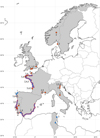 |
Fig. 1 The SYMPA map highlighting in grey the European countries and a North African country represented at the symposium. Coloured dots and lines indicate scientific projects targeting Ruditapes philippinarum (red), R. decussatus (blue), Venerupis corrugata (green), and Polititapes aureus (yellow), either at specific locations (dots) or along broader coastal areas (lines). The numbers above the dot or line refer to the thematic sessions in which the corresponding research was presented. When dots are positioned centrally within a country, they denote projects conducted at a national or fisheries level, without direct field sampling at specific coastal sites. |
4 Futures directions to support sustainable clam fisheries
4.1 Multidisciplinary approach and ability to monitor changes in populations and their drivers
Future management of clam resources requires an integrated and multidisciplinary approach that bridges environmental, socio‐economic, and anthropological dimensions to ensure long‐term sustainability. Combining data from these complementary fields provides a holistic understanding of the complex interactions linking human activities, ecosystem dynamics, and resource productivity. Continuous temporal and spatial monitoring are essential to detect trends, assess population health, and support adaptive management strategies in the face of changing environmental conditions.
4.2 Evolution of human intervention to support ecological function
Restocking initiatives also represent a promising avenue to enhance recruitment and growth, for instance, drawing inspiration from successful Asian practices involving the addition of suitable substrate materials and optimization of seeding sizes (e.g. https://mainichi.jp/english/articles/20251124/p2a/00m/0bu/017000c). This type of action is similar to ‘marine gardening’, in which human intervention supports ecological functions for sustainable clam fishing. It would directly address the issue of habitats in a context where current spatial management (particularly within marine parks) focuses on habitat conservation and restoration. The appropriate level of intervention and its efficiency remain to be assessed, but in any case, such a potential change raises the question of its societal acceptance.
Collaboration with Asian communities (research teams and more globally stakeholders implied in management) including the exchange of knowledge from synthesis works in these regions are particularly valuable to consider any adaptation and refinement of such approaches within European contexts.
4.3 Creation of a European network for Clam research and management
Strengthening collaboration across the European/international scientific community working on specific resources is essential to ensure coherent and effective management of these ecosystems (Johnson et al., 2020). Regarding clams, coordinated efforts among researchers, national authorities, and stakeholders should promote data sharing, harmonized methodologies, and consistent trade measures, including documentation, certification, and traceability standards. Integrating long‐term observations with expert assessments will help address uncertainty and improve methodological robustness.
A collective willingness was expressed to establish an international research network on clams in the coming months, aimed at facilitating active knowledge exchange and collaborative research. This initiative would reinforce European capacities while building on successful experiences and practices developed in Asia.
Based on this shared desire to create such an international network, several countries (Italy, Portugal, England, France, etc.) have expressed their willingness to host the second edition of the international symposium on clams within the next two to three years, thus confirming the relevance and demand for such an event. Collectively, these initiatives aim to address the multifaceted challenges facing clam fisheries, aquaculture, and conservation, with a focus on sustainability, climate change resilience, and improved disease management.
Acknowledgments
This symposium was funded by grants from the Office Français de la Biodiversité (OFB), the Parc Marin du Bassin d'Arcachon (PNMBA), Ifremer, the Université de Pau et des Pays de l'Adour, the Université de Bordeaux (EPOC), the Région Nouvelle‐Aquitaine, the SIBA (Syndicat Intercommunal du Bassin d'Arcachon), and the town hall of Arcachon, whom we warmly thank for their support.
We are also grateful to our professional partners — A. Gueguen (CRPMEM Nouvelle‐Aquitaine), T. Fauvel (OFB – PNMBA), A. Lecanu (SIBA), fishers D. Moulin, M. and Y. Vial (CDPMEM 33), and M. Corbière and her team — for organizing the third day of the symposium and allowing participants to discover Arcachon and the richness of its basin.
Our sincere thanks also go to the Arcachon Convention Center and the interpreters, whose assistance greatly contributed to the smooth running of the event.
Finally, we extend our special thanks to Ifremer — in particular its Scientific Direction, the relevant departments, and the COAST unit — for their continuous support.
Data availability statement
The research data associated with this article are included in the article.
References
- Caill‐Milly N, Riquet F, Bru N, Antajan E, Sanchez F. Book of Abstracts of the International Manila and European Clams Conference (SYMPA 2025), 8-10 September 2025, Ifremer/UPPA, Arcachon, France. [Google Scholar]
- Cash DW, Clark WC, Alcock F, Dickson NM, Eckley N, Guston DH, Jäger J, Mitchell RB. 2003. Knowledge systems for sustainable development. Proc Natl Acad Sci 100: 8086–8091. [Google Scholar]
- Cvitanovic C, Hobday AJ, van Kerkhoff L, Wilson SK, Dobbs K, Marshall NA. 2015, Improving knowledge exchange among scientists and decision‐makers to facilitate the adaptive governance of marine resources: a review of knowledge and research needs. Ocean Coast Manag 112: 25–35. [Google Scholar]
- Cvitanovic C, McDonald J, Hobday AJ. 2016. From science to action: principles for undertaking environmental research that enables knowledge exchange and evidence‐based decision‐making. J Environ Manag 183: 864–874. [Google Scholar]
- Dutra LXC, Thébaud O, Boschetti F, Smith ADM, Dichmont CM. 2015. Key issues and drivers affecting coastal and marine resource decisions: participatory management strategy evaluation to support adaptive management. Ocean Coast Manag 116: 382–395. [Google Scholar]
- Fazey I, Evely AC, Reed MS, Stringer LC, Kruijsen J, White PCL, Newsham A, Jin L, Cortazzi M, Phillipson J, Blackstock K, Entwistle N, Sheate W, Armstrong F, Blackmore C, Fazey J, Ingram J, Gregson J, Lowe P, Morton S, Trevitt C. 2013. Knowledge exchange: a review and research agenda for environmental management. Environ Conserv 40: 19–36. [Google Scholar]
- Humphreys J. The Manila Clam, Ruditapes philippinarum: Science and Significance of a Globalised Species, Elsevier, Amsterdam, 2026 [Google Scholar]
- Johnson MT, Johnson LJ, Bayliss‐Brown GA, Danino V, Day S, Dunnett I, Forster J, Lorenzoni I, Kennedy K, Malin G, Moore K, Moore Fuller P, Walton M, Tolhurst TJ. 2020. The marine knowledge exchange network: insights from an innovative regional‐to‐national scale academic‐led knowledge‐to‐impact network and recommendations for future initiatives. Coast Manag 48: 308–335. [Google Scholar]
- Karcher DB, Tuohy P, Cooke SJ, Cvitanovic C. 2024. Knowledge exchange at the interface of marine science and policy: a review of progress and research needs. Ocean Coast Manag 253: 107137. [Google Scholar]
- Kates RW, Clark WC, Corell R, Hall JM, Jaeger CC, Lowe I, McCarthy JJ, Schellnhuber HJ, Bolin B, Dickson NM, Faucheux S, Gallopin GC, Grübler A, Huntley B, Jäger J, Jodha NS, Kasperson RE, Mabogunje A, Matson P, Mooney H, Moore B, O'Riordan T, Svedin U. 2001. Sustainability science. Science 292: 641–642. [CrossRef] [PubMed] [Google Scholar]
- Turner BL, Kasperson RE, Matson PA, McCarthy JJ, Corell RW, Christensen L, Eckley N, Kasperson JX, Luers A, Martello ML, Polsky C, Pulsipher A, Schiller A. 2003. A framework for vulnerability analysis in sustainability science. Proc Natl Acad Sci 100: 8074–8079. [Google Scholar]
Cite this article as: Riquet F, Sanchez F, Antajan E, Bru N, Caill‐Milly N. 2026. The International Manila and European Clams Conference: Euro‐Mediterranean overview and future directions to support sustainable clam fisheries. Aquat. Living Resour. 39. 4. https://doi.org/10.1051/alr/2025022
All Figures
|
Fig. 1 The SYMPA map highlighting in grey the European countries and a North African country represented at the symposium. Coloured dots and lines indicate scientific projects targeting Ruditapes philippinarum (red), R. decussatus (blue), Venerupis corrugata (green), and Polititapes aureus (yellow), either at specific locations (dots) or along broader coastal areas (lines). The numbers above the dot or line refer to the thematic sessions in which the corresponding research was presented. When dots are positioned centrally within a country, they denote projects conducted at a national or fisheries level, without direct field sampling at specific coastal sites. |
| In the text | |
Current usage metrics show cumulative count of Article Views (full-text article views including HTML views, PDF and ePub downloads, according to the available data) and Abstracts Views on Vision4Press platform.
Data correspond to usage on the plateform after 2015. The current usage metrics is available 48-96 hours after online publication and is updated daily on week days.
Initial download of the metrics may take a while.